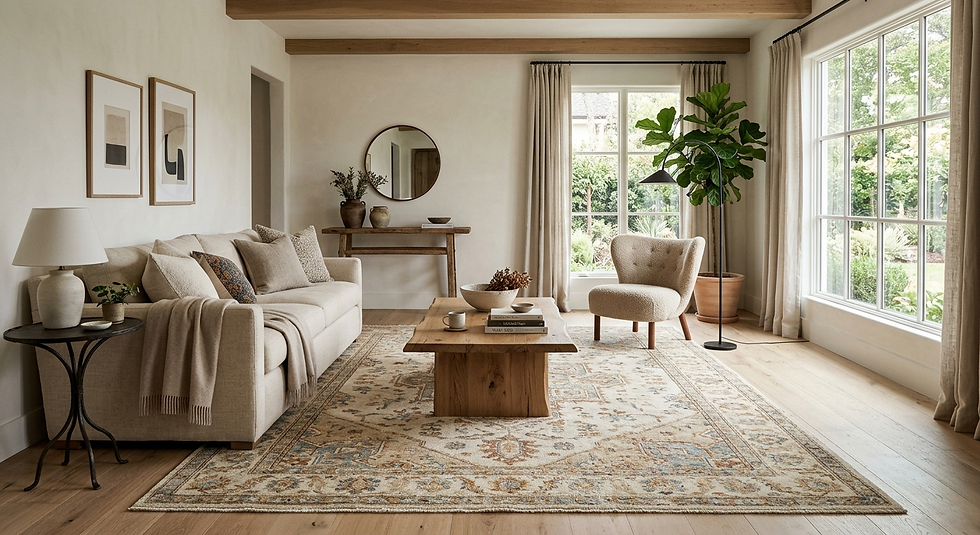
Hand-Knotted vs Hand-Tufted Rugs
What's the difference, and does it actually matter?

People ask me this more than almost anything else. I understand why. Both are handmade, both are beautiful, and the names sound technical enough to feel like a trap.
But the difference between a hand knotted vs hand tufted rug is real. Once you understand it, choosing between them becomes less confusing and more instinctive. It comes down to how each is built, what that means for how it ages, and what kind of design language it can carry.
I've spent years working with both techniques. I've watched weavers tie individual knots for months on a single piece, and I've watched artisans guide a tufting gun across a backing with the ease of someone painting. These are genuinely different crafts. Neither is lesser. They are just not the same thing.
Here's what I think you actually need to know.
Hand Knotted vs Hand Tufted Rug: How They're Made
Hand-Knotted
A hand-knotted rug is made on a loom. The weaver ties individual knots, wool or silk or cotton, around pairs of warp threads. One knot at a time. Row by row. After each row is complete, a weft thread is passed through to lock everything in place, and the pile is trimmed to reveal the pattern.
There is no shortcut to this. A rug measuring 8 by 10 feet might contain two million knots. A skilled weaver working on a finely detailed piece might tie a few hundred in a day. Some of our rugs take the better part of a year to finish.
The knot density, measured in knots per square inch, determines how fine the design can be. A high knot count allows for extraordinary detail. A lower count gives a chunkier, more rustic quality that has its own warmth and character.
The rug carries the time spent on it. You can feel that when you walk on it.

Hand-Tufted
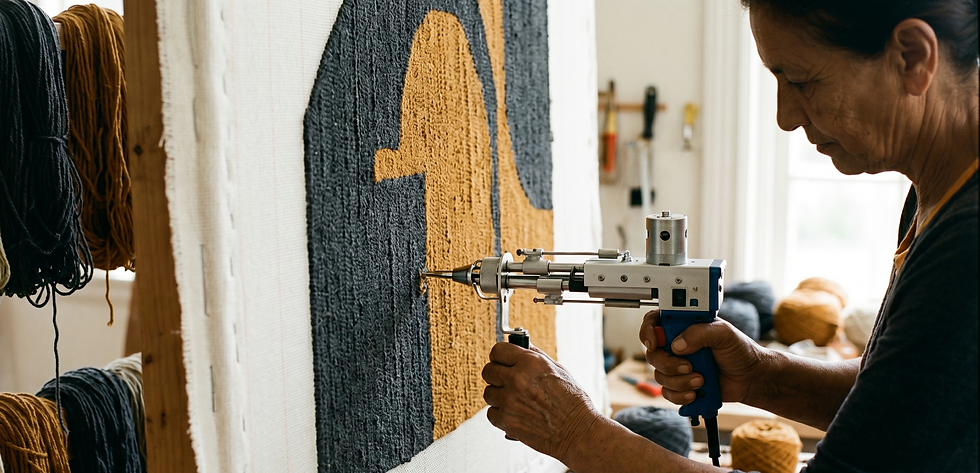
A hand-tufted rug starts differently. The weaver stretches a canvas backing onto a frame and draws the design directly onto it. Then, using a tufting gun, a tool that punches yarn through the backing, the artisan fills in the pattern.
Once the tufting is complete, the back is coated with latex to secure the fibers. A secondary backing of cotton or jute is then applied to finish the underside. The latex is what holds the pile in place. That's an important structural difference from a knotted rug, where the knots themselves provide all the integrity.
The tufting process is faster. A rug that might take eight months to knot can often be tufted in a few weeks. But speed isn't the point. What matters is what the technique makes possible. Tufting gives designers a kind of expressive freedom that knotting, by its nature, constrains. Large abstract fields, flowing organic shapes, bold graphic contrasts. These are native to the tufted form.
A Quick Comparison
Hand-Knotted | Hand-Tufted | |
How it's made | Knots tied by hand onto a loom, one by one | Yarn punched through a backing with a tufting gun |
Lifespan | 75 to 150+ years | 20 to 40 years with care |
Design range | Fine detail, intricate pattern, traditional motifs | Bold, abstract, expressive, contemporary |
Weight | Heavy and dense | Lighter, easier to move |
Time to make | Months to years | Days to weeks |
Price | Premium investment | Accessible luxury |
Best for | Heirloom pieces, traditional spaces | Contemporary rooms, design-forward interiors |
Tantuka example | Silk Road Star, Khotan Collection | Leher, Kinara Collection |

How Long Will It Last?
This is the question I'd want answered if I were buying.
Hand-knotted rugs are extraordinarily durable. Because every knot is structurally independent and woven into the foundation, there is no single point of failure. These rugs age as a whole. The pile flattens slightly underfoot over years. The colours mellow and deepen. The surface develops what rug people call a patina. You are not fighting time with a hand-knotted rug. Time is working with it.
A well-made hand-knotted wool rug, cared for reasonably, will outlast most of the other things in your home. There are pieces from Persia and Central Asia that are hundreds of years old and still in use. I find that genuinely remarkable every time I think about it.
Hand-tufted rugs have a different relationship with time. The latex backing that holds the pile can degrade, particularly in high-traffic areas, in humid climates, or if the rug is cleaned too aggressively. A quality hand-tufted rug, used thoughtfully, will serve you for twenty to forty years. That is a meaningful life for a rug. It is just not the same proposition as a knotted piece.
Neither is the wrong choice. It depends entirely on what you need. If you want a rug for a child's bedroom that will be replaced when the room changes in ten years, a hand-tufted piece makes complete sense. If you want something you'll still have at seventy, you're looking at hand-knotted.
Design and What Each Technique Does Best
This is where the two techniques diverge most visibly.
Hand-Knotted: Depth and Detail
The knot structure lends itself to intricacy. Traditional Persian medallions, Khotan geometric lattices, tribal Berber patterns, fine florals. These designs come alive in hand-knotted construction because the technique can render fine detail at a small scale without losing definition.
There's also a directional quality to hand-knotted pile that you don't get anywhere else. Walk toward the rug and the colour appears one way. Walk away from it and the same rug seems to shift, lighter or darker, warmer or cooler. It's a consequence of how the pile lies. It gives these rugs a presence that's difficult to explain until you've lived with one.
Hand-Tufted: Expression and Contemporary Design
Tufting opens up a different design space. Because the artisan is essentially drawing with yarn, the technique handles large abstract fields, expressive mark-making, and bold graphic forms with an ease that knotting cannot match. Pile heights can also vary within a single piece, cut pile for a smooth velvety surface, loop pile for texture, which adds another dimension to the design.
Our Leher: Kinara Collection exists because of hand-tufting. The movement in those pieces, the way colour shifts and the design breathes, could not have been achieved any other way. The technique was the right tool for that particular vision.
Materials
Both techniques can use the same fibres. At Tantuka we work primarily with New Zealand wool, Indian hand-spun wool, bamboo silk, and cotton. The fibre matters as much as the construction, sometimes more.
Wool is what I'd choose for most spaces. It's resilient, naturally resistant to staining, warm underfoot, and it ages beautifully. New Zealand wool has a finer, lusher quality. Indian hand-spun wool is coarser and more textural. It suits rustic and tribal-inspired work in a way that finer wools simply don't.
Bamboo silk gives a soft, luminous sheen that catches light quite differently from traditional silk, and it's a more sustainable option. We use it where we want a quiet luxury rather than an obvious shine.
Price and What You're Actually Paying For
Hand-knotted rugs cost more. Sometimes significantly more. The reason is straightforward. They take longer to make, they require more skilled labour, and they use more material.
When you buy a hand-knotted rug, you are paying for months or years of a skilled weaver's working life. That isn't a marketing line. It's literally what you're acquiring. The price reflects that honestly.
Hand-tufted rugs are more accessible, and there's nothing apologetic about that. The craft is real. The design can be exceptional. The result is a genuinely handmade piece that brings warmth and character to a room. The price simply reflects a different kind of making, not a lesser one.
The one thing I'd caution against is cheap hand-tufted rugs with poor latex and synthetic fibres. They won't hold up. With any handmade rug, price is a reasonable guide to quality within each category.
Which One Is Right for Your Home?
Rather than a formula, here's how I'd actually think about it.
Think about hand-knotted if:
You want a rug that will be in your family after you're gone
The room is significant, a drawing room, a study, somewhere that warrants that level of investment
You're drawn to traditional patterns, fine detail, or the depth of something made over many months
You want the rug to quietly anchor the room rather than announce itself

Think about hand-tufted if:
You want bold, contemporary, or abstract design with real visual impact
The room will evolve, a living room you'll redecorate in a decade, a child's room
Your budget is defined and you want genuine handmade quality within it
You want a custom piece made to your dimensions without a long lead time
Both will bring something a machine-made rug never can: the mark of the person who made it.
A Note on Custom Work
We make custom rugs in both techniques. The process starts the same way, with a conversation about the space, the design, the materials. The technique we recommend will depend on what you're trying to achieve.
If you have a room in mind and aren't sure which direction to go, I'm always happy to talk it through. Sometimes the answer is obvious. Sometimes it takes a bit of back and forth.
Start a custom conversation: tantuka.com/custom-rugs

Questions I Get Asked
How do I tell them apart when the rug is in front of me?
Flip it over. On a hand-knotted rug you'll see the pattern on the back, formed by the knots. On a hand-tufted rug you'll see a secondary fabric backing, usually canvas or jute, applied over the latex layer. The reverse tells you everything.
Is hand-knotted always better?
More durable, yes. But better depends on what you need. A hand-tufted rug with a strong design in the right space is better than a hand-knotted rug that doesn't fit. The technique is a means to an end, not a virtue in itself.
Do tufted rugs shed more than knotted rugs?
Both types can shed lightly when new, as loose fibers settle out. This is normal and it resolves within a few weeks of regular vacuuming. Tufted rugs may shed slightly more in this early period, but the difference isn't dramatic if the wool quality is good.
Can I order a custom rug in either technique?
Yes. We work in both hand-knotted and hand-tufted constructions for bespoke commissions, along with handloom and flatweave options. The right technique for a custom piece depends on the design intent and we'll help you work that out.
Which is better for a high-traffic area?
For heavy traffic, hallways, entryways, under a dining table, I'd honestly recommend hand-knotted or flatweave. The structure holds up better over time. For a living room or bedroom, either works well.
Explore the Collections
Hand-Knotted Rugs: tantuka.com/category/hand-knotted
Hand-Tufted Rugs: tantuka.com/category/hand-tufted
Wool Rugs: tantuka.com/category/wool-rugs
Custom Rugs: tantuka.com/custom-rugs
All Rugs: tantuka.com/category/rugs
TANTUKA. Crafted slowly. Designed timelessly.
For custom inquiries and trade projects: contact@tantuka.com